Is Your Social Impact Hiding in Your Tail Spend?
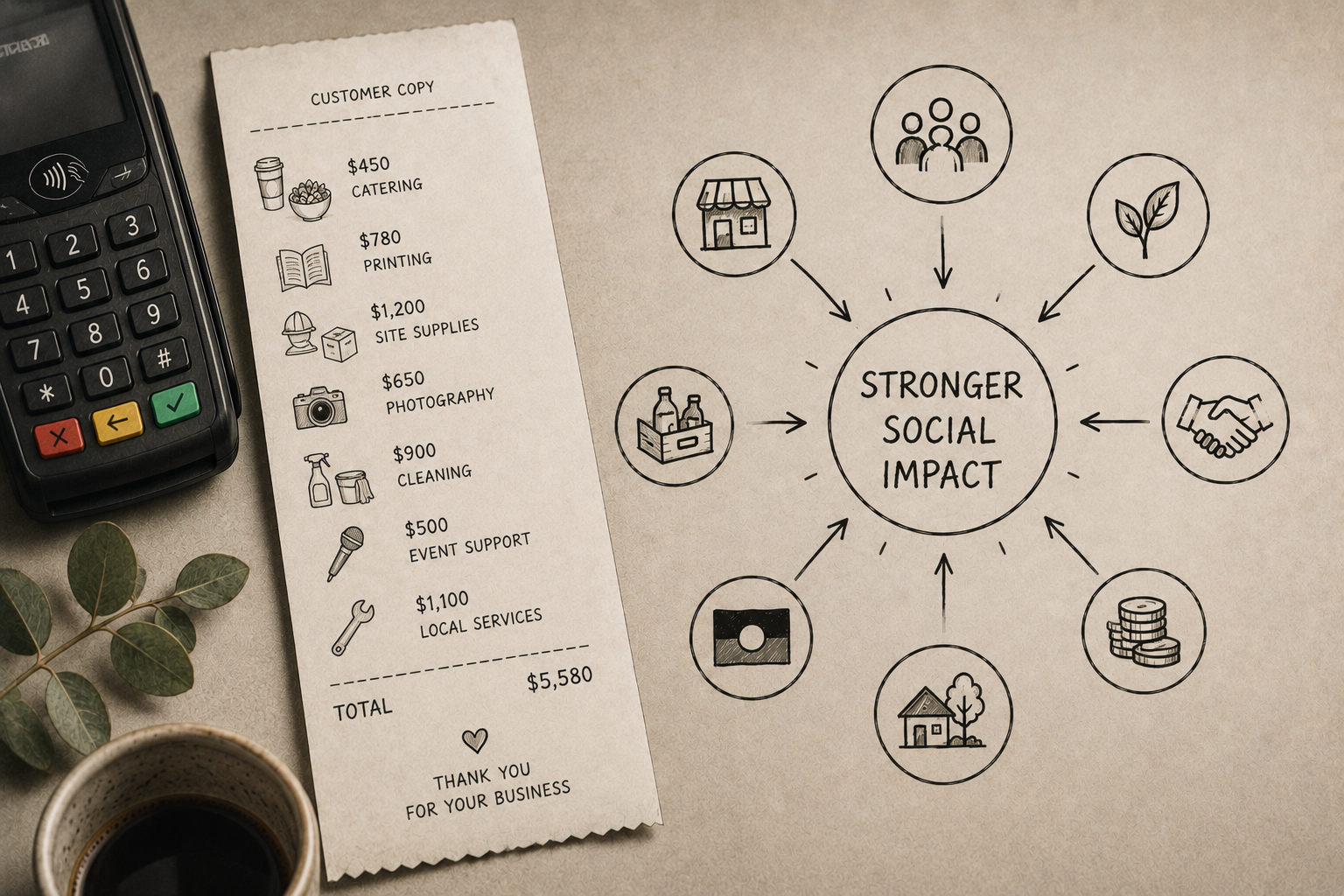
Social procurement strategies tend to focus on the parts of procurement that are easiest to see: major contracts, tender requirements, participation targets, supplier panels and formal reporting frameworks. Yet some of the most accessible opportunities for social impact may be sitting somewhere much less visible, in the thousands of relatively small purchasing decisions made across an organisation every day.
These transactions might involve an Indigenous business, social enterprise, disability enterprise, women-owned business, LGBTQIA+ business, local SME or another diverse supplier. When purchasing is decentralised, however, the economic and social value being created can become fragmented across systems, teams and cost centres.
A team orders catering for a workshop. Another engages a photographer or designer. A project team purchases printing, event materials or specialist services. On a major infrastructure project, mobilisation and day-to-day site operations can also generate a steady stream of local purchasing, from site consumables and cleaning through to accommodation, minor works and operational services.
Individually, these transactions may appear as separate purchasing decisions. Collectively, they can represent a significant flow of expenditure. The challenge is that many organisations are not able to see that collective picture.
The Long Tail of Procurement
Procurement professionals commonly describe this fragmented, lower-value expenditure as 'tail spend'. It typically consists of a high volume of relatively small transactions that sit outside an organisation’s strategically managed procurement categories and may be purchased through corporate cards, procurement cards, expense systems, low-value purchase orders or other delegated arrangements.
There are good reasons for allowing this spending to remain flexible. Requiring a formal procurement process every time someone needs catering, printing, site supplies or a relatively small professional service would create unnecessary administrative burden. More importantly from a social procurement perspective, overly complex purchasing processes can create barriers for smaller and diverse suppliers.
The problem is therefore not necessarily that tail spend is decentralised. It is that decentralisation can make it difficult to understand where the money is going and what outcomes it is already creating.
Consider a frequently purchased service such as catering. One business unit might spend $800 with an Indigenous-owned catering business, another $1,200, another $650 and a fourth $900. Each transaction may appear on a different corporate card, against a different cost centre and under a different employee’s delegation. Viewed separately, these are four purchasing decisions. Viewed together, they represent $3,550 in business flowing to the same supplier and, potentially, the beginnings of a much more significant commercial relationship. The issue is not the size or significance of the supplier. It is the way organisational purchasing systems fragment the spend.
This can be particularly pronounced on major infrastructure projects. During site mobilisation and ongoing operations, project teams often make frequent purchases through corporate cards, site accounts, local suppliers and delegated buying arrangements. Because these transactions can sit outside major subcontract packages or formal procurement reporting, expenditure with Indigenous businesses, social enterprises, SMEs and local suppliers can be difficult to aggregate and recognise at a project level.
What We Measure Shapes What We Value
Social procurement reporting is generally strongest where procurement itself has the greatest visibility. Major contracts can be tagged, suppliers classified, participation targets incorporated into sourcing strategies and Tier 1 contractors required to report on their supply chains.
Tail spend operates differently. Purchasing authority is often distributed across the organisation, with data fragmented across cost centres, expense systems and cardholders. An organisation may therefore have sophisticated reporting on diverse supplier expenditure through its formal procurement systems while remaining largely unable to identify comparable expenditure occurring through corporate cards and other low-value purchasing channels.
This creates an important distinction. The organisation may not have an impact problem at all. It may have a visibility problem. If the expenditure cannot be seen, it is difficult to understand, report or intentionally grow. Organisations may also be understating the contribution their everyday purchasing decisions are already making to social enterprises, Indigenous businesses, diverse suppliers and local economies.
Do Not Solve a Visibility Problem by Creating a Participation Problem
One response to fragmented spend is to bring more expenditure under central procurement control. In some circumstances that may make sense, particularly where there are issues relating to risk, duplication or value for money. From a social procurement perspective, however, centralisation should be approached carefully.
One of the advantages of corporate cards and delegated purchasing is that they allow lower-value transactions to happen quickly and with relatively little friction. That ease of transaction can be an important part of market access. A supplier providing a relatively low-value service should not necessarily need to complete a lengthy onboarding process, respond to a tender, navigate a complex purchase order system and then wait extended payment terms simply because an organisation wants greater visibility over its spend.
The objective should therefore not be to make tail spend more difficult. It should be to make its impact more visible. Better social procurement does not automatically require another approval, form or compliance process. In many cases, the stronger intervention is to preserve the simplicity of delegated purchasing while improving the quality of the information captured around it.
From Procurement Control to Procurement Enablement
Looking at tail spend through this lens also changes who participates in social procurement. Procurement teams remain important, but many everyday decisions about where organisational money flows are made by executive assistants, office managers, project managers, event teams, site managers and others with purchasing authority. Collectively, these employees make thousands of choices about which suppliers are used. The opportunity is therefore not simply to impose greater control over those decisions, but to better enable them.
Organisations could make diverse and impact-led suppliers easier to find, create simple supplier guides for commonly purchased goods and services, improve the way supplier classifications are captured within expense systems, and analyse card spend alongside traditional procurement data. For infrastructure projects, this can begin during mobilisation. Rather than waiting until a project is operational, teams can identify likely categories of recurring site spend early and make appropriate local and social suppliers visible to the people who will be making those purchases.
The principle is simple: make socially responsible purchasing options easy to identify, easy to use and easy to measure.
From Transactions to Relationships
Improved visibility can reveal something more valuable than a better reporting number. It can show where a series of distributed purchases is becoming a meaningful commercial relationship.
A social enterprise might receive repeated orders from different teams across an organisation. An Indigenous business, disability enterprise, women-owned supplier, LGBTQIA+ business or regional SME might appear again and again across corporate card transactions without procurement ever recognising the scale of the relationship.
The same can happen on a major project, where a supplier initially engaged for a specific site need becomes a trusted provider across multiple teams or stages of delivery. At that point, the question changes from how much are we spending? to what could this relationship become?
Repeated purchasing can provide evidence of demand, capability and trust. With the right visibility, procurement and supplier diversity teams can identify businesses that are gaining traction organically and consider how that relationship might grow, whether through introductions to other teams, greater supplier visibility, capability development or a more structured commercial arrangement where appropriate.
Seen this way, tail spend can form part of a broader supplier development pathway:
ACCESS → DEMAND → RELATIONSHIP → GROWTH
Looking Beyond the Big Contracts
Major contracts and strategic sourcing will always remain central to social procurement, but social and economic participation is not created only through tenders. It is also created through the thousands of everyday purchasing decisions made across an organisation, including those made during project mobilisation and ongoing site operations.
A $500 transaction may sit below the threshold of strategic procurement attention, but when those transactions are repeated across an organisation or project they can represent meaningful revenue, sustained relationships and a pathway to larger commercial opportunities. The next opportunity in social procurement may therefore be less about creating another policy or procurement process and more about understanding the economic activity that is already occurring outside the traditional line of sight.
Some of an organisation’s most accessible opportunities for social impact may already be sitting in its tail spend, including the everyday purchasing happening across offices, projects and operational sites. The first step is being able to see it.
If your organisation is looking to better understand where social value is already being created across procurement, corporate card spend and project purchasing, Tika EQ can help you map the gaps, improve visibility and identify practical opportunities to grow impact without adding unnecessary process.
Talk to us about making your social procurement spend more visible, measurable and intentional.